Thursday, June 25, 2015

Viper Wine, Book Review

Viper Wine by Hermione Eyre
Viper Wine is set in 17th century Britain and revolves around the relationship of Kenelm and Venetia Digby, their love for each other and the individual obsessions that destroy their love. For Sir Kenelm, alchemy and the quest for knowledge become his hamartia while Lady Digby’s fatal flaws are youth and beauty.

Ms. Eyre does a masterful job of exploring Venetia’s vanities and her dependence on viper wine to maintain her beauty. And lest the reader feel too superior, the author juxtaposes Venetia’s foolishness with our own society’s youth and beauty obsessions resulting in everything from fad diets to breast enhancement to liposuction. However, in exploring Sir Kenelm’s folly, the author misses the mark. Kenelm is a bit too disconnected from the narrative and his own life for the reader to fully vest in him. And the brain messages he receives are often jarring to the narrative flow of the text.

Despite this, the writing itself is usually clean and lovely. I felt like with a bit more editing, particularly in the last quarter, this novel could have been a more fluid and engaging read.

N.B. I received this book from Blogging for Books in exchange for an honest review.

Friday, June 19, 2015

Book Review, Emotions in the Wild


I received a free copy of this book in exchange for an honest review.

When I first heard about this book, I was struck by how much I wanted it. How it filled a need I didn’t even know I had.

As any writer knows, one of the most difficult things to communicate is the emotion of a character. How can you communicate a character’s feelings subtly yet distinctly? In other words, how do you show these emotions to your reader without telling them? And how can you do so without using clichés?

Ms. Garver’s book Emotions in the Wild is a guided journal that shows writers how to use the power of observation in their everyday lives to create an “emotions bible” to guide them in crafting a unique reference book for their writing, a personal source book for help in describing what an emotion (anger, jealousy, etc.) looks like, sounds like, and even how it might be provoked.

The book begins with an introduction explaining how to use the journal. The rest of the book is divided into emotion chapters—a total of 39 different emotions are given for examination. Each chapter includes pithy quotations from famous individuals to stimulate thought about the emotion. Following the quotes are sections where the writer records observations on the particular emotion’s “Common Triggers,” “Facial Expressions,” “Postures and Movements,” “Range of Reactions Observed,” and “Related Words, Idioms, and Phrases.”


In the past when I’ve been stumped with how to describe or explain something, I’ve often used Roget’s “Concept Index,” but now I’m looking forward to incorporating this journal into my life and watching it bear fruit in my writing. Five Stars! Click here to buy it.

Me and my copy.

Wednesday, June 10, 2015

Stainless Steel Man

Matt leaving the hospital.
I wanted to title this post “Iron Man,” but Matthew isn’t Iron Man. He’s Medical Grade, Stainless Steel Man. During the surgery (see previous post), Matthew had two metal bars and two small plates implanted into his chest. That sounds cool. The reality…not so much.

Here are the recovery highlights.

1. Matthew is five weeks into recovery—which means that in one more week, he’ll be able to bend, twist, lay on his side, use a pillow, and get in and out of bed on his own. Woot!

2. He has discovered that when he breathes (even though it’s painful), his chest expands out to the sides. Before, he was using his stomach muscles to breathe.

3. Matthew can never be a recreational drug user. According to the anesthesiologist, morphine has no effect on him. (Yeah, you take encouragement wherever you can.)

4. I realize that he’s a much better patient than I would ever be. I know I’d be whining and complaining.

5. I've caught him with refrigerator magnets, trying to figure out if they'll stick to his chest.

6. He is not above taking advantage of his situation.

     A. This morning, he pointed at the French press. I said, “Pour it yourself.” He said, “It’s more than two pounds.” I poured him a cup—but I’m seriously thinking of weighing the pot.

     B. I am not always as quick at doing what he wants when he wants it.

The only chair he’s allowed to sit in is a massive wingback chair, which has to be carried wherever he wants to be. That thing is a beast, so I’m not always eager to move it. The other day, I found Matt in the living room sitting in the wingback, which had been in the dining room.

I said: How did that thing get in the living room?
Matt: I dragged it.
Me (hands on hips, narrowed eyes): Dude, that’s way more than two pounds
Matt (smirking): I dragged it with my foot.
Me: So you balanced your unsteady body on one foot, dragged the chair with the other?
Matt: Yep.
Me: And the possibility of falling during this feat of gymnastics?
Matt: (shrug)
Me: To the long list Things-You-Are-Not-Allowed-To-Do add dragging chair with your foot.

Now if I take too long, Matt says, I’m thinking of dragging the chair with my foot.

I respond: If you do, I will pick up a tree and kill you. Because if you do something stupid and those bars pop, you'd rather be dead.

Monday, May 11, 2015

Things I Learned in the PICU

 Recently, my son Matthew had cardio-thoracic reconstruction surgery. Even though he’s almost 19, it’s considered a pediatric surgery, so he’s been in the PICU (pediatric intensive care unit) for eight days and counting. Here are a few things I’ve learned in the PICU.

1. PICU has the nicest nurses. Hands down. Bar none.

2. Laughter is still the best medicine.
  •    Matthew asked me to call Miracle Max while Matt was still only “mostly dead.”
  •    Matt got so tired of the respiration monitor alarming because he was breathing too slowly that he’d occasionally pant just to mess with the machine.

 3. It is a truth universally acknowledged that the baker’s dozen of technological marvels that monitor and maintain post-surgical health will inevitably malfunction, but only between the hours of midnight and four am. Also, these wonders have alarms that squawk every two seconds and are only fixable (or mutable) by a specialist who lives 700 miles away.

4. Eye rolling is a good thing. The other day, the physical therapist said, “Sweetie, I know you’re feeling a bit better—you just rolled your eyes at me. Yay!”

5. Healthy hospital food isn’t healthy if it’s inedible. Nothing is as unappetizing as a plain, microwaved boneless-skinless chicken breast sitting on Styrofoam. (Except meals that don’t even arrive. Yeah, that happened more than once.) Eventually, we told them we no longer required their food, and we brought Matt food from home. The nurses apologized profusely for the horrid food. But it wasn’t their fault.

6. When a visiting great dane licks your hand, it’s better than morphine. A hospital employee (who will remain nameless) may have offered to get our black Lab Jezebel into the hospital to visit Matthew. We assured said employee that this would not be wise.

7. The ability to walk should never be taken for granted. Because the surgery reshaped Matt’s chest (and consequently his spine, giving him one or two inches in new height), it has completely altered his sense of balance. As Matt practices walking, Cal and I stand very close on either side so he can “ping-pong” off us as he moves down the hall. It makes him look like a drunken zombie. But as he lurches through the PICU, the nurses cheer as he relearns balance. (Like I said earlier, best nurses ever.)

8. One of the amazing things I learned is that aside from the single incident of eye-rolling, Matthew is the most gracious, patient person I know. He bore the pain, setbacks, and discouragement with quiet dignity that was a wonderful testimony to Christ’s strength. I know I wouldn’t do as well.

So now that we’ve learned these lessons, we’d really like to leave. Soon. 

Before surgery!

Several days after surgery with pain under control.
Matt's dinner. I don't think our dog would eat this.
Calvin and I having a picnic with good food.
 (Yesterday, I got a Mother's Day gift from the PICU. They gave gifts to all moms who were spending the day in the PICU. Did I mention how great the nurses are?)


Wednesday, April 29, 2015

My Own Postage Stamp Garden

I decided to take the things that I learned from The Postage Stamp Vegetable Garden and begin my own postage stamp garden. (Click here to read my review of this fascinating book.)

I don’t have the space for a 5 x 5 garden or even a 4 x 4 garden, but I applied the principles to my south-facing flowerbed. Also, I didn’t make a raised bed. Hopefully, in the autumn my husband and I can do that. But we just didn’t have time this year. Our youngest son is having a cardio-thoracic reconstruction in early May, and it was all we could do just to prepare the flowerbeds for planting and get the seedlings in place.

My space measures 2.5’ x 44’. (It seems like a huge space. But since much of it is unusable because it abuts the side of the house of driveway, it’s still a small space.) In this space, my husband and I planted:

12 white corn plants
6 jalapenos (Yes, I realize how many peppers that will give me. My guys live on peppers.)
1 habanero (Scoville rating: 250,000)
1 ghost pepper (Scoville rating: 1,001, 304. Matthew is giddy about this.)
4 red bell peppers
4 yellow bell peppers
4 beefsteak tomatoes
1 purple cherry tomato
2 cucumbers
Mint (Properly contained in a fabric-lined pot, set into the ground)
Chocolate mint (Same as above)
Chives
Sage
Oregano
Thyme
Tarragon
Basil
Strawberries (I originally had six plants. Now I have more than I can count.)


Here are some photos of the beds. I'll post more later in the summer as the plants mature.

Most of what you see here are the strawberries and herbs
I've been growing for several years. 

Some of the pepper plants are behind me.
Corn plants are beyond that.

 Habanero (foreground) and ghost pepper.
Black tubing is drip irrigation.

N.B. My blogging, which has gotten sporadic, will probably be even more sporadic over the summer since my son's surgery has a 12 week recovery. 

Friday, April 24, 2015

Power of a Lightning Bug

File:Photuris lucicrescens.jpg
Lightning bug photo by Bruce Marlin,
courtesy of Wikimedia Commons


Last night when I was trying to sleep, I discovered that a lightning bug was stuck in the bedroom--my own private lightning storm. It reminded me of Twain's quote, 'The difference between the right word and the almost right word is the difference between lightning and a lightning bug.' Let me just say, in the right context a lightning bug can be pretty powerful!

Thankfully, my twenty-year-old son took care of my bioluminescent problem. Though it left a glowing streak on the wall.

Tuesday, April 21, 2015

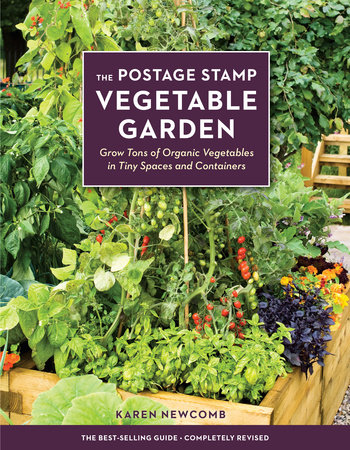
The Postage Stamp Vegetable Garden, Book Review


The Postage Stamp Vegetable Garden 
by Karen Newcomb

N.B. I received this book from Blogging for Books in exchange for an honest review.

From the moment I saw this book, I knew I had to have it. I love vegetable gardens, and I only have a very tiny space, a flowerbed actually. While this book doesn’t specifically address flowerbed vegetable gardens, everything in it applies to what I’m doing and shows me how to have a more productive garden.

The book begins with a wonderful historical overview of postage stamp gardening before getting down to the nitty-gritty of the process. Perhaps some gardeners aren’t as interested in the history of gardening, but I love knowing that these techniques have proved tried and true since the 1890s.
After introducing small space gardening, the author lays out raised bed options and vegetable arrangements for everything from 4’ x 4’ bed to a 8’ x 10’ bed (promising a minimum of 200 lbs. of fresh vegies and herbs from a 5’ x 5’ bed.) The layouts are not only well thought-out but also aesthetically appealing. 

Having discussed the physical arrangements of the garden, the book details soil amendments, watering, disease/pest control*, and how you can possibly grow vining vegetables (even melons) in such a small space. Finally, the author explains which plants are best planted next to each other in order to encourage healthy growth and productivity.

I’m very excited about this book! It has shown me how to alter my gardening techniques to radically increase the amount of food I can raise in an extremely limited area.

As for buying the book, don’t think twice. Buy it! You’ll be glad you did.


*The methods in this book are organic. Even if you don’t do organic gardening, this is still a great book that will cut down on the use of fertilizers and pesticides using simple techniques.