Wednesday, November 14, 2012

Epic Battle of Cultural Neuroses


The other day I purchased a battery powered, hands-free soap pump. I had sneered at these in derision only weeks ago because I thought they were overpriced, faux-tech gizmos. Then, I needed a new hand soap container.

Yes, I know I can get a cheap Softsoap pump with soap in it. But they’re small, and we are big hand washers in our house. Even with extra large soap containers, I have to refill them once a week. (Remember my ethnic background is Dutch. Even the Pilgrims when they were living in Leiden said, “The Dutch clean things before they’re dirty.”) So, while I’m cooking, I wash my hands numerous times, especially with chicken. Cal thinks I’m a bit neurotic—he’s wrong. And as proof of this fact, no one in our house has ever had food poisoning.

The other problem is the extra large soap pumps break easily. So I found myself at WalMart (ugh) pricing new pumps. The price of a massive pump and hands-free pump were the same. So, of course, I bought the hands-free—no more pressing the pump with my elbow to avoid getting raw chicken liquids on the pump.

Everything was going along swimmingly. Until the hands-free pump got some water spots. I tried to clean it. And it dispensed soap all over me and itself.

Very carefully, I wiped the extra soap and water spots. And it dispensed soap again. At this point, Cal burst into laughter. What would win in my battle with the soap container—the need to be clean or the need to be thrifty. Cal settled in for the epic battle of cultural neuroses (it’s not neurotic though, just saying).

But then, to Cal’s chagrin, Ariel said, “Hey, just turn off the switch, and you can clean it.” So, I did. Of course, I should’ve known. I turned on the switch to begin with. 

Here's a photo. I got it for $6 at WalMart. Soap was extra.

Monday, November 12, 2012

Guest Post: Elements of Voice

Today I'd like to welcome Laurel Garver to the blog. She writes the blog "Laurel's Leaves" and is the author of the recently released novel, Never Gone. (NG has just made it to the top of my Kindle TBR list, and I can't wait to read it.)

Elements of Voice

Sometimes the term “voice” is used interchangeably with “style.” What I’d like to talk about is not that sense of “authorial voice,” but rather how to develop character voices that are distinct from one another. If you write from multiple points of view, this is an essential craft to learn. But it’s also helpful for making sure that your fiction isn’t one-note and that the characters around the protagonist seem just as unique as he or she does.

Diction 
How do the characters say what they say? This will reflect their levels of education, local dialect and to a degree their temperament. A morose Oxford graduate will have a different manner of expressing himself than a scrappy graffiti writer from the Bronx.

Here are a few examples from my novel Never Gone. Can you guess which is the teen from New York, which is her middle-aged British uncle and which is her grandfather from central Pennsylvania?

-- “Your mother ain’t right in the head, seems to me. When you love someone, you can’t throw it away. You hang on with every ounce of strength. Right?”

 -- Cecily bubbles with fake cheer, no doubt trying to make up for being such a grinchy wench to me lately. She tells a dorky story about crushing on Ollie Mawbry, and her little horse-riding escapades to spy on him. No surprise he ignored her. Guys don’t exactly dig stalker chicks.

-- “It’s good of you to take an interest in Liza’s pony,” he says. “She’s always banging on endlessly about him. It’s hard for us to be enthusiastic anymore.”

Notice the use of cadence (speech rhythm) and key terminology. You immediately get a sense of place from “ain’t” and “banging on.” You get a sense of age from “right in the head” and “stalker chicks.”

Developing varied diction comes from doing lots of research. A few places to start: Keep a log of overheard conversations and transcribe speech from YouTube videos. Beware of taking your cues from TV, film or other novels, because those writers may not have worked from life. Go to the source as much as you can.

 Associations 
These “tip of the mind” thoughts are a huge part of character voice because they tell a tremendous amount about a person in just a few words. Think of the word-association games psychotherapists use. When your character hears the word “home,” does he think “fried chicken,” “fear,” or “fantasy”? Any one of these answers gives a window into an intriguing story. Associations can be a shorthand way of showing what kind of past experiences the character has gone through, what he values, and what forms of culture shape him. Associations show up in the way characters describe things, and especially how they make comparisons, such as similes and metaphors.

Here are a few associations at work from Never Gone:

--Images burst in my mind like sudden sun through stained glass. (association of a church-goer)

--“Crikey,” Uncle says. “We’re in Dante’s eighth circle of hell.” (association of a reader of classics)

Attitudes 
Attitudes are essentially value judgments made about elements of the world around us--what is good or bad, valuable or worthless. Attitudes most often come out when a character is confronted with something new, unusual or unexpected. The fireworks display is awesome or lame; the new teacher is nice or mean or airheaded or so cool; the flat tire is infuriating or just typical of my hopeless life. Look back at my first examples and you'll see strong expressions of attitudes. Danielle's grandfather finds fault with how her mother grieves. Dani herself is exasperated with her aunt's attempts to be cheerful. Dani's Uncle appreciates what he sees as her patient forbearance of his child, who he judges as repetitive.

Diction and associations will play into how attitudes are expressed, but by golly, all characters should have them. A character that never expresses an attitude will come off as emotionless, or perhaps on the autism spectrum. He’ll see fireworks and say “chemical explosions are causing light effects in the sky.”

Getting to know your characters beyond just age and occupation will help you develop distinct voices that engage readers and make your story come alive.

Which elements of voice come most easily to you? How might research help you create more distinctive voices for your characters?

====

Laurel Garver is the author of Never Gone, a novel about grief, faith and finding love when all seems lost. A word nerd, Indie film enthusiast and incurable Anglophile, she lives in Philadelphia with her husband and daughter.

Trailer for Never Gone


Add it on Goodreads. Read a sample chapter.

It is available as an ebook and a paperback at Amazon.com, Barnes and Noble, Kobo, Smashwords, CreateSpace.

Friday, November 9, 2012

Web Spiders and Louboutin

Over the last month, I’ve been getting a truck load of blog spam. I know, I know, I could add a word verification. But I really hate those. When I see the random combo of numbers and letters, my brain turns the random assortment into real words. “Nmrado” becomes “random” when I type it in. (Yes, this is a great skill in Scrabble and Boggle. Not so much otherwise.) I’ve been known to get an “incorrect” so many times that I thought the system was rigged against me. Now I type those things in with only an index finger so my brain can’t fix it.

The odd thing is that the blog spam comments are only on one blog post. Now I’m sure there’s a sophisticated computer-tech reason that would explain it. Like the HTML code has an embedded 404 compiler error. (Yeah, that probably makes no sense. But I think imps run computers with their evil black magic anyway, which is why the computer always crashes before I remember to save my document on days when I’ve made impressive progress on my novel.)

Anyway, the real reason the post is spammed is that it’s titled “Bob the Criminal Strikes Again.” And the topic of the post was identity theft—someone (Bob the Criminal) filed a fake tax return under my husband’s social security number and tried to get our money. (BTW, the government still hasn’t fixed the problem. But that’s another story.)

So I believe that some criminal syndicate has an evil web crawler (known as web spiders—I love bugs— though not mosquitos or cockroaches, which are pure evil disguised as bugs) searching the web for vulnerable people. And the spider added my blog post because it decided than people who’ve been victims of identity theft are more likely to buy knock off Christian Louboutin shoes or Coach bags because they’ve had their funds sucked dry. But here’s the thing. I really don’t want to wear knock offs of $3000 shoes. (Are the real ones comfortable? Or made out of gold?)

Okay, I just Googled a pair of $3000 suede crystal encrusted open-toed pumps. And I was all prepared to hate them. But, um, they’re really pretty.

Maybe those spiders know what they’re doing after all.  (They're from the Neiman-Marcus website.)

Wednesday, November 7, 2012

Writing Voice: Getting Through the Squeaky Stage


Yesterday, I was discussing voice with a writing friend. She’s just begun a new novel and was anxious because she didn’t have the voice down. I reminded her of my favorite quote about first drafts, “A first draft is a celebration of everything that can go wrong on a page.”

But then, we began to discuss voice in more depth. She mentioned that when she writes short stories, the voice is always there at the beginning. And as I thought about it, I realized that when I write shorts, I always start with a voice. But when I write a novel, I never start with a full-formed voice (although with sequels it’s easier because the voice is already established).

Then the ten thousand dollar question is “Why.” What’s the difference? I think because a short story is so focused around the narrative voice, everything (plot, character, etc.) flows from that voice.

But novels are altogether different. Even the simplest novel, is a series of “clashes” between character, plot, tone, and voice. Not only are the characters refined as they bump up against each other, but the characters are sharpened by the plot. And the plot is honed by the tone and voice, which in turn influence the characters. And not until you get all of these ingredients into the cauldron of the novel, does the magic elixir of voice finally rise to the top.

I’m not saying that there isn’t some sort of voice at the beginning. I think you do start with an immature voice—you have to. After all, the voice helps to control where the story goes. But I think when you start a novel with a “little boy’s voice.” It’s squeaky and cute, not what you want to end up with, but it communicates and sets the arc of the story.

As the novel matures through revision, the voice changes. It takes on nuance and inflection. It deepens, much like the little boy whose voice goes through puberty to become a wide ranging tenor or rumbles in a bass profundo.

What about you, writers? Is this your experience of voice? Or do voices come to you fully formed and mature? (If so, I’m really, really jealous.)

Monday, November 5, 2012

Screwing Up Babylon Release Party

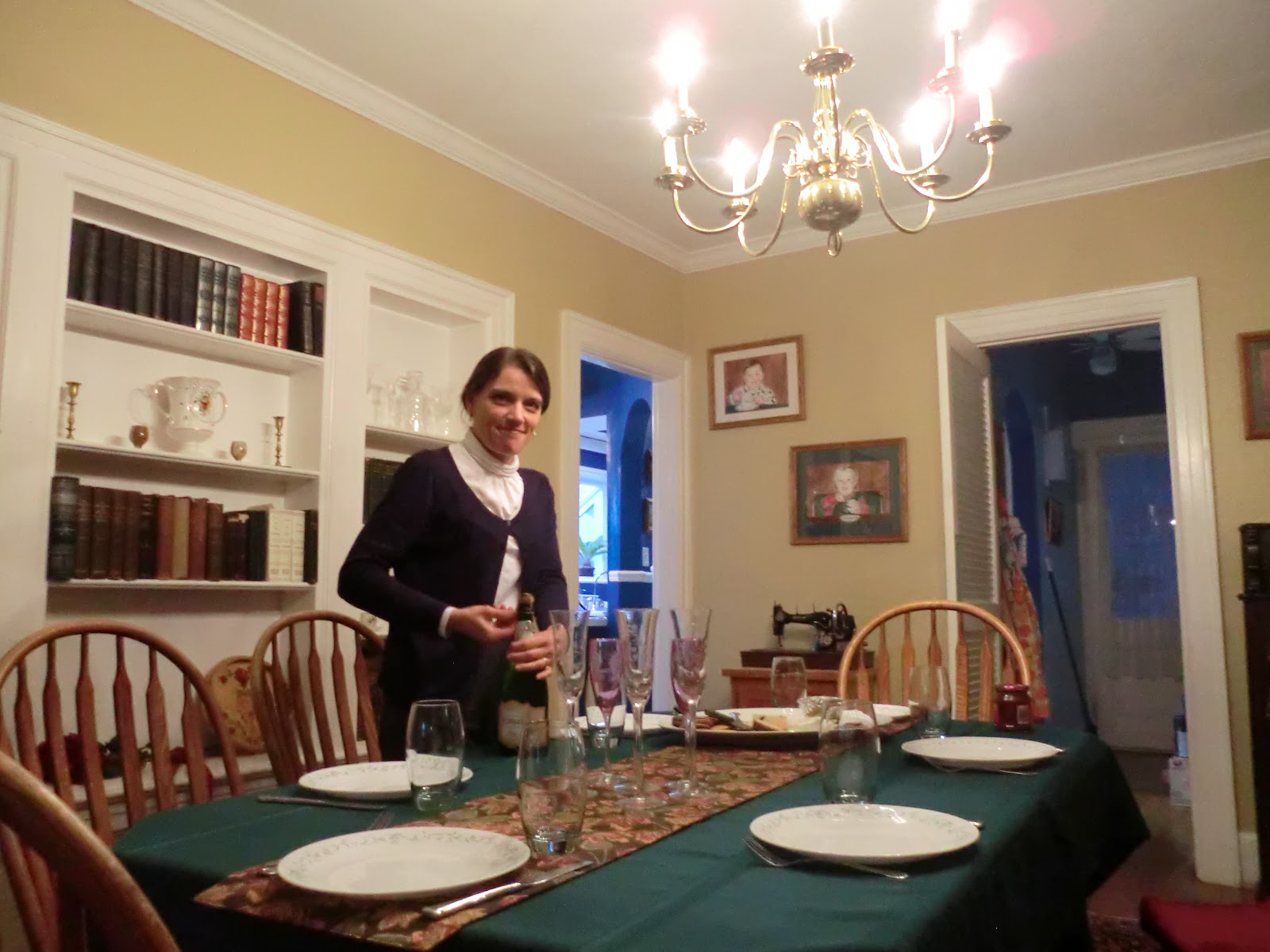
Late Friday night Screwing Up Babylon went live on Amazon, we had a release party here at home.


And I promised photos. Unfortunately, I gave the camera to my 16 year old son. He took scads of photos--of the champagne. You'd think he'd never seen champagne before.

Here are two photos he took of me. (Also with the champagne bottle.)


And he took one photo of some of the food. Wensleydale with cranberries, smoked salmon with cream cheese, jalapenos, crackers. There was also chocolate and a West African beef stew.


We had a great time, even if there aren't many pictures to prove it.

And the sales seem to be going well. Here's a link to the book.

Friday, November 2, 2012

Screwing Up Babylon Release!

Screwing Up Babylon is now available at Amazon. Click here.

Shredding the Bedding


Lots of people have been posting on Facebook and other places about participating in Thirty Days of Thanksgiving. I began to ponder some of the more unusual things I have to be thankful for like a husband who puts up with my sleep idiosyncrasies.

I sleep-talk a lot. (Though I will say, Cal needs to be thankful that I’m not my cousin who’s known to sit bolt upright in bed during the middle of the night and “sing” at the top of her lungs. You’ve never experienced sleep issues until you wake up at 2am to someone screaming “Jesus Loves Me” at the top of her lungs.) In any case, when Cal and I first got married, he didn’t realize I talked in my sleep. He’d thought sleep talking was the occasional mumbled word. Not the ramblings that went on and on. It wasn’t until he realized that I didn’t always make sense that I was asleep.

Then there are the times I wake him saying, “The police are pounding on the front door. Go answer it.” Except it’s only a dream. When I’ve been insistent, he’s actually gone down two flights of stairs and opened the door for me. Now he rolls over and says, “Go back to sleep.”

I can’t forget the sleep walking where he finds me and brings me back to bed.

But what would drive me crazy if he did it is the “bedding shredding.” No, I don’t kick the sheets around or pull the blanket loose. I actually shred the bedding. I wake up with sheets torn all around me. On some nights, I become the Incredible Hulk and rip the sheets. Thankfully, I’m not that strong and sheets are well made, so it only happens when the fabric is getting old from repeated washings. I’ve even shredded a heavy wool blanket. (Yes, I know I’m some sleep doctor’s key to the lead article in the Journal of Sleep Medicine.) If Cal had woken up among puffs of shredded wool, I would’ve said, “Ack, what did you do? Do you know how much a wool blanket costs?” Instead, he said, “Hmm. I guess that must be getting old.”

Yeah, he’s pretty much a saint. Last week, I ripped a pillowcase during the night—I guess it must have been getting old.

BTW, Screwing Up Babylon will soon be available. (In spite of Sandy) Today I plan to convert the file and upload it to Amazon. Yay!