Showing posts with label Ehlers-Danlos Syndrome. Show all posts

Tuesday, May 21, 2024

Ehlers-Danlos Syndrome Awareness

 May is Ehlers-Danlos Syndrome Awareness Month. As someone with this rare genetic disease, I want to do my part so more people are aware of it. I hope someone will see these photos and say, "Hey, I can do that" and won't wait decades, getting sicker and sicker, before they are diagnosed.

This is one of many EDS "party tricks."
If you cover my pants with your hand, my head looks like it's on backward.

Cute EDS Awareness t-shirt.

This is the EDS "gang sign.
Take your thumb and touch your forearm


Wednesday, February 16, 2022

HEDGE Study, Ehlers-Danlos Syndrome

 
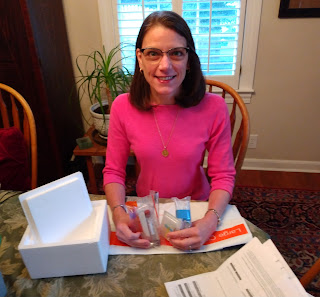
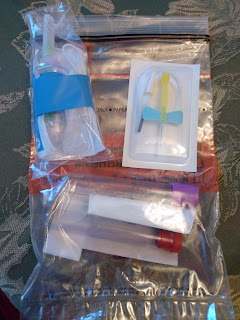
Early this morning, I had my blood drawn. And aside from the fact that I’m a difficult stick because my veins collapse, this shouldn’t be something to write a blog post over. But this is a big deal.

 I was invited by the Ehlers-Danlos Society to participate in the HEDGE study. Its goal is to find the genetic markers for the type of Ehlers-Danlos Syndrome I have. They will do a whole-genome sequencing study of 1,000 people from 86 different countries who have hEDS.

I’m very thankful to everyone who has donated time, money, and blood to run this study. (It’s hard to find research money for rare diseases.) My hope is this study will make diagnosis quicker and easier and raise awareness in the medical community, so that no one else will have to wait 50+ years for a diagnosis. Go, zebras!


Friday, September 10, 2021

Friday Five: Living with a Nasty, Incurable, Rare Disease


Yes, living with a nasty, incurable, rare disease is horrible. It is also very funny. Or, perhaps, I have a gallows sense of humor.

 (Before I start this, let me say, since I’ve received my diagnosis, all my doctors have been infinitely kind and caring. I wish all the doctors before the diagnosis had been the same. But that’s another story.)

 How doctors respond to me and Ehlers-Danlos Syndrome.

 When I meet a doctor for the first time, they usually have not looked at my chart. I understand—too many patients, too little time. After greeting me, they say, “So what brings you in today?” I smile my I-hate-to-do-this-to-you-smile and say “I have Ehlers-Danlos Syndrome.” Doctors respond in many ways.

 1. The doctor blinks. He/she blinks because the diagnosis rings a vague alarm bell in their mind. But only a vague one. The doctor makes polite conversation and excuses themselves. While I wait, they are Googling EDS on “Google for Doctors.”

 2. The doctor is disconcerted by getting stuck with an Ehlers-Danlos Syndrome patient. “So, you have ED…”

I try really, really hard not to laugh. In some alternate, doctor world, maybe ED is an acronym for EDS. But in the patient world, ED stands for something else, and I don’t have it.

 3. They pale. My favorite response is the doctor who said, “I read about it in medical school. So, um, why don’t you tell me whatever it is you need, and I’ll greenlight it.”

 4. They try to fix me before they know what’s wrong. These are the doctors who look at my medications list before they look at my diagnosis.

 Doctor: You are on a lot of medications. How do you feel about that?

Me, I feel @#!#? about it, but I say: Well, I have Ehlers-Danlos Syndrome.

Doctor: Oh, right. Good. So, these medications are propping you up.

Me: Yep.

5. The doctor pulls up my x-rays: Doesn’t say a word because he/she is gasping. A second later, he/she is figuring out how to pretend they didn’t gasp.

 I know it’s a Friday Five, but this is your lucky day because I have six.

 6. The doctors perform a procedure (or surgery): These always go wrong. Really, really wrong. When I am awake for the procedure—not often the case—but when I am, I hear the assisting resident say to the other doctor, “Did you see that? What the *%#* happened?”

I tried to warn them beforehand. Honest, I did.

Nota Bene: I included the cute zebra photo because zebras are the mascot for EDS. The photo is from Wikimedia Commons.

Friday, May 1, 2020

Ehlers-Danlos Syndrome Awareness Month

What’s up with EDS?

1.       It’s a rare genetic connective tissue disorder named after two dermatologists who each wrote about patient who had skin that was hyperextensible—super stretchy.

2.       It’s a collagen disorder. Since collagen is in almost every organ, tissue, and system, they can all be affected. That means the pain is chronic, often excruciating, and exhausting. (And no, taking collagen doesn’t solve the problem because our bodies take the collagen from what we eat and drink to build the collagen we need, but EDS bodies build it incorrectly.)

3.       It’s genetic, but not all affected family members share exactly the same symptoms (though they will have the same subtype). It’s also much more commonly diagnosed in women—hormones may affect gene expression.

4.       There are 13 subtypes, each with its own problems and prognosis.

5.       Getting diagnosed. Studies show that it takes the average EDS patient 19 years (yes, 19 years!) to go from showing symptoms to diagnosis. It took 37 years for me to go from symptoms to diagnosis. Partly, it’s because EDS is so rare most doctors haven’t seen a patient with EDS. The 2017 estimate is that somewhere between 1 in 5,000 to 7 in 1,000 people have the type of EDS that I have.

6.       Why is a zebra the mascot for EDS? Doctors are taught when you hear hoofbeats think horse not zebra. After all, it’s pretty rare to find a zebra. But they exist—and so do people with EDS, even though we’re few a far between. 😊


Thursday, March 5, 2020

Rare Disease Day, Ehlers-Danlos Syndrome


The zebra is the mascot for EDS because medical professionals are often taught,
 when you hear hoofbeats, think horse not zebra. But people with EDS are zebras.
Image courtesy of Wikimedia commons
February 29 was Rare Disease Day. I’m a few days late, but here’s my rare disease story: Ehlers-Danlos Syndrome (incidence 1/10,000 to 1/20,000 for my subtype).

After a lifetime of knowing something wasn’t quite right with my body, a geneticist recently diagnosed me with Ehlers-Danlos Syndrome, a genetic connective tissue disease, which affects all the body’s organs and tissues causing deterioration and degeneration. The subtype I have is characterized by pain and exhaustion. (Honestly, I don’t remember a time I wasn’t fighting pain or exhaustion—I thought it was normal. I told myself, “Suck it up, Buttercup.”) Without going into the nitty-gritty, the geneticist explained my condition this way: Imagine your body is a house built with nails that are soft. It’s not too bad at first. But over time, the nails fail. The shingles and siding blow off. The wallboard falls down, and the floors come apart. And, the 2 X 4s holding the structure together start to separate from each other.  (Not the most encouraging metaphor…)

There is no treatment for EDS. The only thing doctors can do is treat the symptoms. Because my house is in its fifth decade, a lot of things are falling apart (spine, joints, eyes, digestive system, circulatory system, etc.). But I am thankful. After 53 years, it’s nice to know why.